

Studying the application of machine learning to the design of retrofit projects
Context and challenges
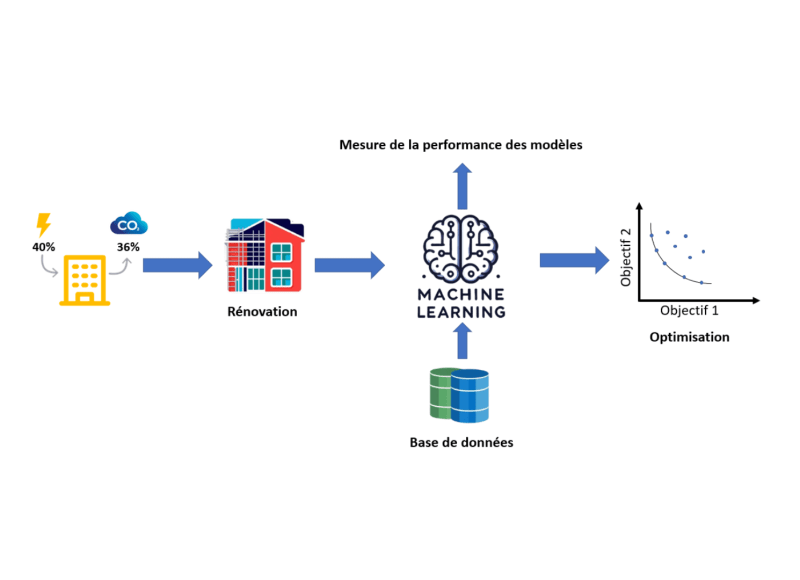
As a major energy consumer, the building sector represents a significant potential for action, with the thermal retrofit of the existing stock being an essential challenge. Optimisation techniques can reduce heating, and even cooling, consumption at lower cost. The value of artificial intelligence is twofold: on the one hand, a meta-model derived from machine learning makes it possible to reduce computation time compared with a physics-based numerical simulation, which is very useful because optimisation requires a large number of calculations. On the other hand, the meta-model can avoid the collection of a large amount of data, which is suitable for the upstream phase of a project during which the company must invest time without being certain of being selected.
Objectives and method
This study aims to develop predictive models, such as neural networks and random forests, to quickly estimate the energy performance of buildings and integrate them into a multi-criteria optimisation process (cost, energy and/or environmental performance). To this end, a database will be built from simulations of buildings with different retrofit strategies. These data will be used to train and test the meta-models, which will then be used to identify the best retrofit solutions, while assessing the uncertainties and the robustness of the results.

CEEP
- About
- Researchers
- Practitioner groups
- Research areas